Rob Ryan conceals his connection to the 1984 disappearances
In the WoodsRob Ryan’s concealment of his connection to the 1984 disappearances shapes both his investigation and the account he gives of himself. The secret is not simply a fact he fails to disclose: he recognizes that the new case may intersect with the events of his childhood, understands the professional consequences of admitting his personal involvement, and deliberately keeps O’Kelly uninformed. As memories begin to return, the silence that once seemed useful becomes part of a more unstable struggle over what Rob can remember and what still belongs to him.
Identity and the hidden past
As a child, Rob was known as Adam Ryan and lived in Knocknaree. When he went to boarding school, he began using his middle name. He cannot say whether his parents suggested the change or he chose it himself, but he regards it as a practical decision in the wake of the publicity surrounding the missing children. He remembers furtively searching newspapers, tearing out relevant coverage, memorizing it in private, and flushing it away. With so many Ryans in Dublin, he reasoned, the change made it less likely that anyone would connect Detective Rob, with his English accent, to Adam from Knocknaree.
His knowledge of the childhood case remains tightly restricted. His parents know, as does Cassie Maddox; he also once told a boarding-school friend and a former girlfriend. He avoids speaking about the episode because he expects questions about memories he does not possess and speculation about his mental state. The concealment is therefore not absolute, but it is carefully bounded: Rob controls who hears the story and keeps it apart from his public identity.
The decision to remain on the case
When the investigation into Katy Devlin’s death begins to look connected to the old disappearances, Rob knows he should tell O’Kelly. He nevertheless says he never seriously considered doing so. Police rules prohibit an officer from working on a case in which personal emotional involvement may compromise judgment; Rob expects disclosure to get him removed and to bring renewed questioning about the day in the wood. He tells himself that reopening that process would help neither the case nor the community.
The earlier interviews have left him with a vivid memory of not being able to answer. In the weeks after the childhood event, questioning seemed to reach him only faintly, while his awareness was occupied by drifting clouds, open sky, and wind across grass. He recalls feeling as if his mind had been wiped and replaced by an empty test pattern. Detectives returned repeatedly, at first during school holidays and later about once a year, but he had nothing to tell them. Eventually they stopped. Rob regarded that as the right decision and saw no good reason to reverse it now.
His explanation also includes a less defensible attraction to secrecy. In retrospect, he admits that the idea of carrying a charged, undiscovered secret through the case appealed to his ego and to his taste for the picturesque. This admission complicates his practical rationale: keeping silent preserves his place in the investigation, but he also enjoys imagining himself as an enigmatic maverick. The concealment is presented not as a single clean motive, but as a choice supported by professional self-interest and a flattering private story about who he is.
The new case brings the old one into view
Cassie identifies a possible connection between Katy Devlin’s murder and the disappearance of Peter Savage and Jamie Rowan in Knocknaree in 1984. The cases share the children’s age and location; beside Katy’s body, investigators have found old blood being compared with samples from the earlier case, as well as a hair clip matching the description of one worn by the missing girl. Cassie says they cannot rule out a link. O’Kelly challenges the possibility of a serial offender acting after two decades, but Cassie explains that O’Kelly had instructed the team to familiarize themselves with cold cases.
Rob’s physical reaction makes the professional discussion personally charged: even hearing Cassie state the connection raises his heart rate. He calls himself a capable liar and notes that O’Kelly is more perceptive than he lets on. The gap between the team’s public working theory and Rob’s private history therefore becomes a source of tension. Cassie is not simply introducing an old case as a line of inquiry; she is naming evidence that reaches into a past Rob has chosen not to put before his superior.
Recovered memories and their disappearance
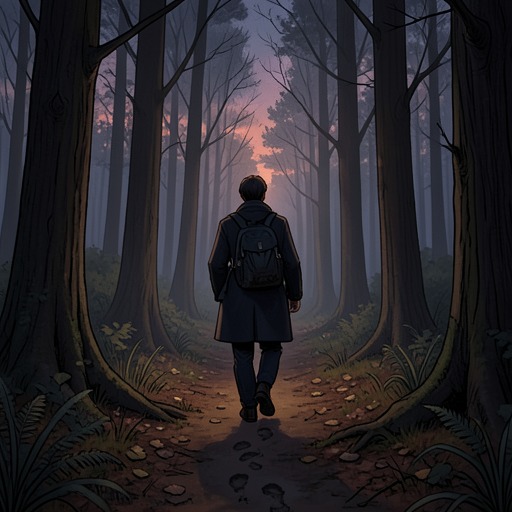
During the investigation, Rob begins trying to remember the wood deliberately for the first time. Unable to sleep, he walks through the city in the early hours, sometimes coming to himself far from where he expected to be. Images emerge in fragments: childhood scenes with Peter and Jamie, details of the neighborhood, and memories that offer no immediate help with the case. Their force comes partly from his accustomed belief that the first twelve years of his life were largely gone; even an ordinary recovered detail feels momentous because it seems to offer a piece of the missing past.
One memory eventually returns with exceptional force. Rob wakes in the night and recalls approaching a clearing with Peter and Jamie, where they encounter an assault on Sandra Scully. The memory supplies a disturbing childhood scene that had been inaccessible to him, but its vividness does not restore a stable, complete account of the past. Later, during Operation Vestal, he tries to follow another fragile thread of recollection; the surrounding wood seems black and blank, and the effort is accompanied by intense physical strain and fear that the memory will vanish.
After the investigation, Rob’s memories of Peter, Jamie, the men in the wood, Sandra, and the place itself are gone again. He can remember having once remembered them, but they now seem distant, like scenes from old films or stories belonging to someone else. Only one image remains: Peter and Rob lying in Peter’s front garden, trying unsuccessfully to make a periscope from rolled newspaper because they could not ask their mothers for the cardboard tube they needed. The lasting failure of the recovered memories sharpens the cost of Rob’s concealment. He had treated the past as a secret he could carry at will; by the end, even the memories he managed to retrieve no longer feel securely his.